Winston & Strawn – Intent‑Driven Experience Search
Overview
Designed and deliver AI search platform as part of digital transformation project of the corporate intranet. The new AI‑powered internal search experience focused on answering Requests for Information (RFIs) and surfacing institutional knowledge across the firm.
Rather than building a traditional enterprise document search, the engagement centered on experience search—helping attorneys and business professionals quickly answer questions such as who has done what, for whom, and in which legal contexts by combining structured data, unstructured content, and inferred expertise signals.
The Challenge
Like most law firms, the firm’s internal knowledge was distributed across multiple systems, including document management, data marts, and CRM‑like sources. While information existed, it was difficult to answer common, high‑value questions without manual outreach or email‑based RFIs.
Key challenges included:
- Reducing internal RFI traffic by enabling self‑service discovery
- Detecting user intent behind natural language queries
- Surfacing people, matters, clients, and experience—not just documents
- Balancing relevance, explainability, and trust in AI‑assisted results
- Designing an extensible architecture that could evolve as firm needs changed
Sample Queries/Intents:
Contact Search
Query Form
who do we know at {entity:company} Example Query
who do we know at Caterpillar Expected Results Contacts from the CRM who work at Caterpillar. Further, the results should display how at the user might be related to the contact.
Active Matters
Sample Form
What are the active matters for {entity:company} Example Query
What are the active matters for caterpillar? Expected Results
Should display an answer card that displays the number active matters for the company and a list of the matters underneath.
Experience Search
Query Form
What experience do we have with {entity:legal-area} Example Query
What experience do we have with Patent Law? Expected Results
List of matters by for legal area rank by experience ranking described below
Solution
Mock up of experience
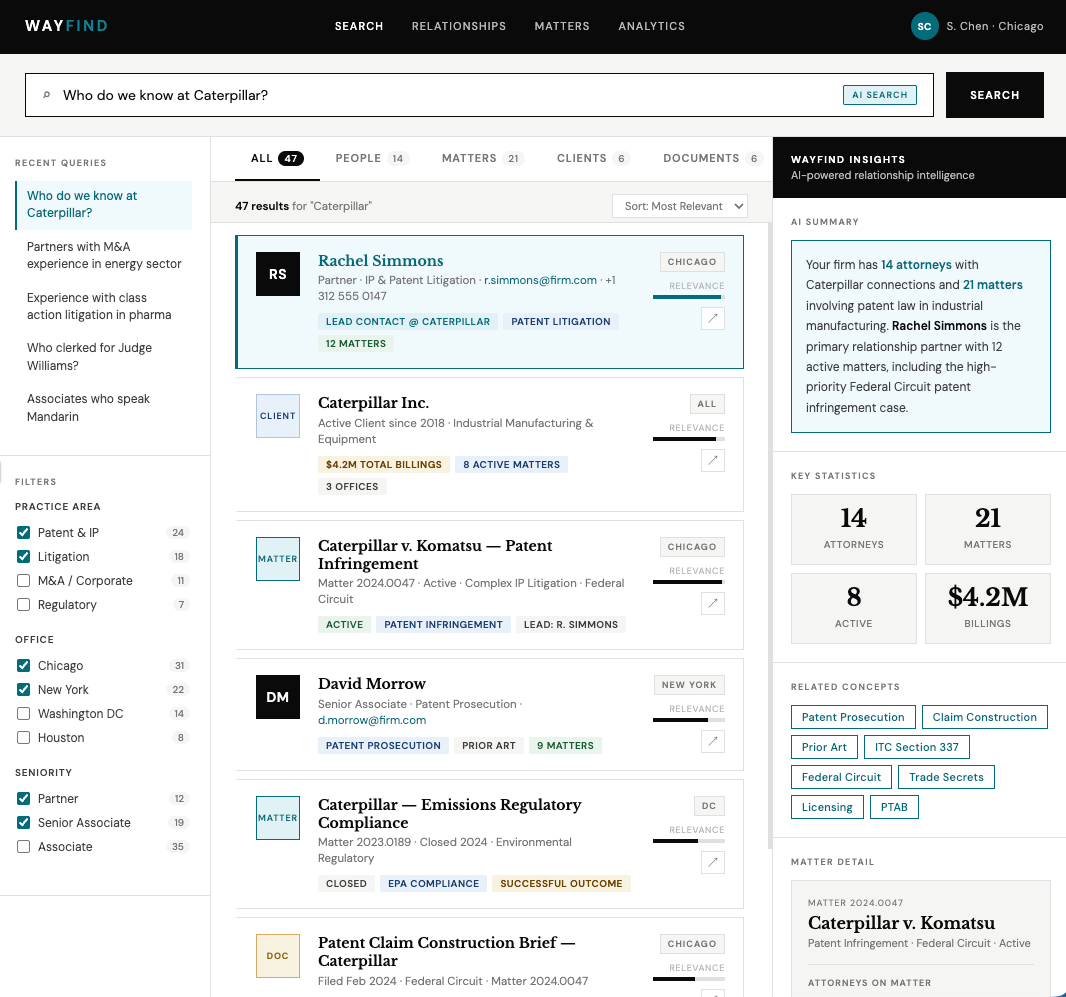
Designed and implemented an intent‑driven insight engine built on Elasticsearch with a query intent classifier that routed the query and a domain‑specific knowledge graph, optimized for legal experience discovery.
1 – Intent Detection & Query Understanding
Search queries are classified into explicit intents—such as finding an expert, identifying prior experience, or locating active matters—allowing the system to route queries to the most appropriate retrieval and ranking strategies rather than relying on keyword matching alone.
2 – Experience‑First Result Modeling
Instead of returning long lists of documents, we prioritizes answers: people, clients, matters, and legal experience summaries synthesized from multiple data sources. This approach mirrors how attorneys think about knowledge while preparing pitches, responses, and client conversations.
3 – Knowledge Graph‑Driven Relevance
Entities and relationships (lawyers, matters, clients, practices, industries) are modeled explicitly, enabling:
- richer relevance signals
- explainable ranking logic
- future expansion into analytics and recommendation use cases
4 – Phased Delivery & Knowledge Transfer
The engagement followed a phased approach—from architecture and intent modeling through UI design and handoff—ensuring internal teams could operate, tune, and extend the system over time.
Technologies Used
- Elasticsearch
- Rasa Open Source
- BA Insight Connector
- Kerberos
- Machine Learning
Results
- Enabled attorneys to answer common RFIs without email‑based escalation
- Improved relevance by aligning search behavior with legal user intent
- Shifted internal search from document retrieval to experience discovery
- Delivered a repeatable architecture extensible to future data sources and use cases