The release of more than three million pages of Epstein-related documents under the Epstein Files Transparency Act has been framed primarily as a political reckoning. For risk managers and particularly ones at private equity firms and hedge funds, it should be read as something more uncomfortable: an operational audit they didn’t ask for, revealing KYC frameworks that were never designed for the risks they actually face.
The names appearing in the files — Goldman Sachs’s chief legal officer, the chair of a leading law firm, a former U.S. Treasury Secretary, a sitting Commerce Secretary — are not names associated with conventional compliance failures. These are not sanctioned entities. They are not flagged in OFAC databases . They passed every standard onboarding check their institutions conducted. And yet their proximity to Epstein’s network has triggered resignations, investigations, and in some jurisdictions, criminal proceedings.
That gap between what standard KYC captured and what actually mattered is the central risk management question of this moment.
The Architecture of the Failure
KYC , as operationalized across most financial institutions, is fundamentally a point-in-time exercise. A counterparty is screened at onboarding against sanctions lists, PEP databases, and adverse media. A risk tier is assigned. Periodic refresh cycles run on twelve- or twenty-four-month cadences. The file is closed.
This architecture was designed for a specific threat model: the onboarding of bad actors who are already known to regulators. It is largely adequate for that purpose. It is structurally blind to a different and increasingly prevalent risk category — what might be called network contamination risk: the possibility that a counterparty who is clean at onboarding becomes material reputational, regulatory, or legal exposure through the subsequent revelation of their historical associations.
The Epstein corpus makes this concrete. The risk signal is not contained in any single structured database. It is distributed across 300+ gigabytes of flight logs, contact books, email metadata, court documents, SAR narratives, and investigative records — the overwhelming majority of it unstructured text. Standard KYC infrastructure, built around structured entity screening, has no mechanism to ingest, parse, or continuously monitor against a corpus of that kind. The exposure is not to what the counterparty is doing now. It is to what they were doing, with whom, in a period that predates or falls outside your monitoring window.
Standard KYC has no answer for this. The question is whether your intelligence infrastructure does and will you find out first or on the news.
The Corpus Risk Problem
On January 30, 2026, the Department of Justice released the largest single tranche of Epstein materials: more than three million pages alongside thousands of videos and images, now housed in a searchable public database. This corpus is permanent. It is machine-readable. It will be indexed, cross-referenced, and mined by journalists, regulators, plaintiffs’ attorneys, and algorithmic compliance tools for years.
This changes the risk calculus in a way that deserves explicit recognition. Historical association risk — the kind that used to dissipate as memories faded and documents remained sealed — has been structurally transformed. What was once episodic and perishable is now persistent and searchable.
For PE firms and hedge funds, the practical implication is this: any LP, GP, portfolio company executive, board member, or counterparty whose name appears in that corpus carries a new category of latent exposure. The exposure may never materialize. But it cannot be managed if it is not first identified, and the window to develop a considered response closes the moment a journalist or regulator identifies it for you.
Adding to this is the ever day discussion of additions and missing documents.
The Jurisdiction Asymmetry Makes This Harder
The Epstein files have not landed evenly across geographies, and the divergence has direct implications for funds with cross-border LP bases or portfolio exposures.
In the United Kingdom, accountability has been rapid and severe. Former Prince Andrew was stripped of royal titles, then arrested on suspicion of sharing confidential trade documents with Epstein. Norwegian diplomatic resignations followed within days of relevant names appearing in the files. European law enforcement agencies have opened investigations based on the released documents, operating under legal frameworks that create shorter paths from documentary evidence to formal proceedings.
In the United States, the same documents have produced a more muted response — a consequence of structural features of American political economy that provide greater insulation for high-net-worth individuals with political connectivity. Several senior American figures named in the files retain their positions.
For a fund with London and New York offices, or with European institutional LPs, this asymmetry is not academic. A counterparty whose name in the files creates manageable reputational friction in one jurisdiction may create a material compliance event in another. Risk frameworks that fail to model jurisdiction-specific accountability dynamics are operating on an incomplete map.
What Modern Intelligence Infrastructure Actually Does
The operational gap the Epstein files expose is not primarily a data gap. The underlying information — flight logs, contact books, email metadata — existed in law enforcement systems for years. The gap is one of continuous, structured visibility into how that information intersects with your specific exposure surface.
This is where the distinction between a KYC database and a properly architected market intelligence portal becomes operationally meaningful — and the Epstein corpus illustrates it with unusual clarity.
Consider the query a risk manager actually needs to answer today: which counterparties in our LP base, portfolio, or leadership network have documented associations with individuals named in a newly released federal corpus, and what does their full transaction and relationship profile look like? A sanctions screening tool cannot answer that question. It was not built to. Answering it requires the ability to ingest large volumes of unstructured text, perform entity resolution across disparate sources, traverse relationship graphs to surface second- and third-degree connections, and return results at investigative speed — across billions of dynamically linked records.
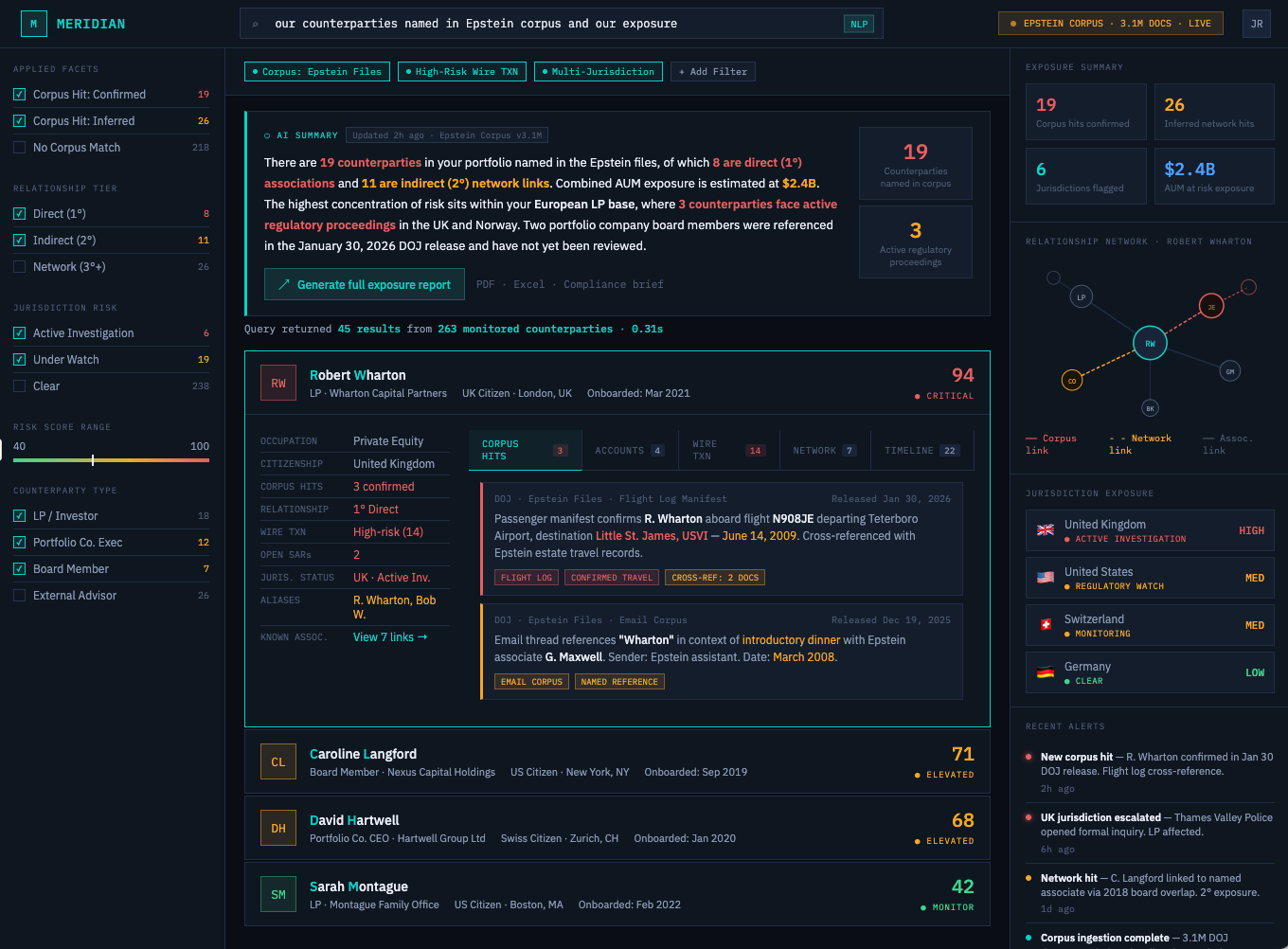 A market intelligence portal answers that query in real time — surfacing corpus exposure by counterparty, relationship tier, and jurisdiction, with an AI-generated fund-level risk summary, in the time it takes a compliance analyst to open a spreadsheet.
Deployments of AI-powered investigation infrastructure at major financial institutions have demonstrated what this capability unlocks in practice. As Gartner observed in its 2024 Banker’s Guide to AML Tools for Productivity , transaction monitoring systems that generate excessive false positives overwhelm investigators to the point where
“increases in efficiency and productivity for existing case investigators are absolutely essential for banks that cannot afford to hire ever more new investigators.”
The same report found that raising AML investigator productivity by even a few percentage points within case management will likely outweigh all additional vendor costs — making the ROI case for modern intelligence infrastructure straightforward. Real-world deployments bear this out: AI-based triage systems have demonstrated false positive reductions of up to 80% while maintaining over 90% detection of actual suspicious activity, and institutions that have centralized multi-source data into unified investigation platforms report dramatic reductions in mean time to resolution. These are not theoretical gains. They reflect what happens when natural language querying, and machine learning are applied to the kind of multi-source, unstructured-data problem that the Epstein corpus represents.
The architectural difference is not incremental. A KYC database tells you whether a counterparty is on a list. A market intelligence portal — one that continuously ingests regulatory filings, litigation records, legislative releases, adverse media, and public document corpora — tells you whether a counterparty is becoming a risk event, in real time, across jurisdictions, before that risk event becomes someone else’s headline.
Three properties define the gap:
Speed. The window between a document corpus entering the public record and the first wave of adverse coverage is measured in hours. An organization that learns of a named counterparty’s exposure from a Financial Times story is already in reactive posture. Continuous monitoring infrastructure surfaces the exposure at corpus ingestion.
Network depth. Epstein’s network was not a collection of bilateral relationships. It was a multi-tier graph. Moving from screening a node to understanding its full relationship graph — across linked accounts, transactions, aliases, and unstructured narratives — is the difference between knowing a name appears in a document and understanding what that appearance means for your specific exposure surface.
Regulatory anticipation. The Epstein files have already accelerated the political argument for tightening AML and KYC requirements. Deutsche Bank’s $225 million in combined penalties for processing suspicious Epstein-linked transactions is the precedent regulators will cite. Funds that can demonstrate continuous, documented monitoring of counterparty risk are substantially better positioned in a regulatory examination than those whose compliance files show point-in-time snapshots on annual refresh cycles.
The Broader Principle
The Epstein files are an extreme case, but the underlying dynamic is not. The permanent, searchable disclosure of previously sealed relationship corpora is becoming a recurring feature of the regulatory and legal landscape — through FOIA litigation, congressional subpoenas, regulatory enforcement actions, and the accelerating digitization of historical records.
Each such release creates a new corpus risk event. Each event has a specific intersection with your fund’s exposure surface that is unique to your LP base, your portfolio, your leadership team, and your counterparty network. Generic adverse media screening, calibrated to catch known bad actors, was not designed to surface that intersection. It will not.
The risk managers who recognize this distinction — and build or procure intelligence infrastructure that reflects it — will be measurably better positioned than those who treat the Epstein files as a one-time anomaly and wait for the news cycle to move on.
The news cycle will move on. The corpus will not. Stay Tuned
This analysis reflects publicly available information as of February 2026. It does not constitute legal or compliance advice.