Transforming Product Discovery with Intent‑Aware AI Search
Overview
Over the past 20 years, I have worked with Molex to design and implement a next‑generation, (and eventually) AI‑powered search and discovery experience for its global digital platform. The engagement focused on modernizing how customers and engineers discover products by moving beyond keyword‑based search toward an intent‑aware, generative experience that understands what users are trying to accomplish and surfaces the most relevant solutions.
Rather than treating search as a simple retrieval problem, the solution reframed product discovery as a decision‑support experience. The goal was to help users answer questions such as which product fits a specific application, how similar products compare, and what choice best meets technical and operational constraints.
The Challenge
Molex offers an extensive and highly technical product catalog spanning industries, applications, and global markets. While product data and content were plentiful, customers often struggled to quickly identify the right product for their needs using traditional search experiences.
Key challenges included:
- reducing friction in early‑stage product evaluation
- supporting complex natural‑language queries from engineers and buyers,
- improving relevance across a large and multilingual catalog,
- balancing precision with exploration
- and creating a flexible architecture that could evolve as AI capabilities matured.
Sample Queries and Intents
Product Fit and Recommendation Typical query form: Which connector works for a specific application at a given specification? Example query: Which connector works for a 4‑circuit, 10 amp industrial application? Expected results: A ranked set of recommended product families with clear explanations of suitability and trade‑offs. Product Comparison Typical query form: Compare one product family versus another product family. Example query: Compare Mini‑Fit Sr. versus Mega‑Fit. Expected results: A synthesized comparison highlighting electrical, mechanical, and application‑level differences. Product Understanding Typical query form: What is a specific product family used for? Expected results: A concise, AI‑generated summary grounded in authoritative product data.
Solution
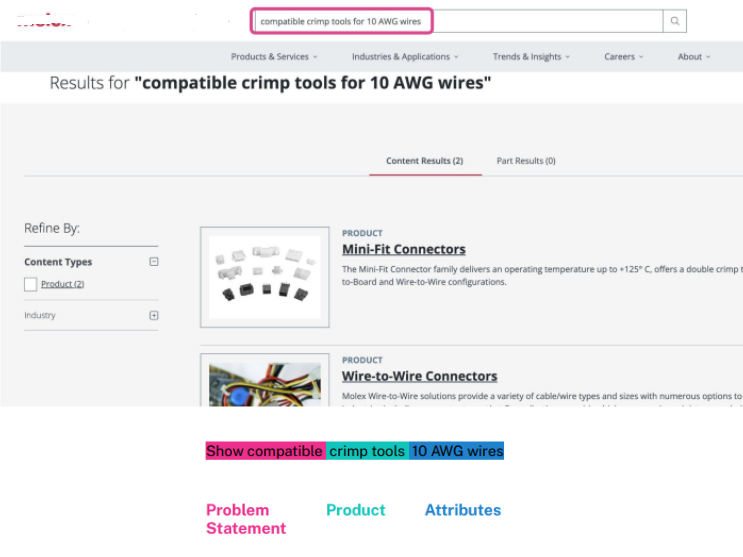
Designed and implemented an intent‑aware, search platform built on Lucidworks Fusion and augmented with AI techniques like Learn To Rank. The solution enhanced query understanding, relevance, and product comprehension while remaining extensible for future use cases.
1 - Intent Understanding and Natural Language Search
User queries are interpreted using natural language processing and intent‑aware techniques to distinguish between exact part searches, exploratory discovery, comparisons, and informational queries. Each intent is routed through an appropriate retrieval and ranking strategy rather than relying solely on keyword matching.
2 - Hybrid Retrieval for Precision and Recall
The platform combines traditional lexical search with semantic and vector‑based retrieval. This approach allows engineers to find exact parts when requirements are well defined, while also discovering relevant alternatives when flexibility exists.
3 - Generative Product Summaries and Explanations
Designed a solution to generate generate clear, structured summaries and comparisons of product families for queries such as “10a 5pin header”. This helps users quickly understand differences, trade‑offs, and suitability without navigating multiple documents or data sources.
4 - Relevance Engineering and Signal Learning
The engagement included extensive relevance testing and tuning. Field boosts, ranking logic, and behavioral signals were adjusted to ensure the most meaningful results surfaced consistently across key product discovery scenarios.
5 - Phased Delivery and Operational Handoff
The solution was delivered through iterative phases, starting with strategy and prototyping and progressing through production configuration and handoff. This ensured Molex’s internal teams could operate, extend, and evolve the platform independently over time.
Technologies Used
- Lucidworks Fusion / Solr
- Spark for bulk data processing
- Salsify integration for product data
Results
- Improved product discovery for complex, technical queries
- Reduced time required to identify appropriate product families
- Shifted search from keyword matching to intent‑driven guidance
- Established a scalable foundation for future AI‑powered customer experiences